Memory
Memory Preflight
Use retrieval drift as a candidate maintenance signal, not source truth.
Open routeAI Research System / Project-System Improvement
Project-system improvement is not research continuation. It is a bounded maintenance loop for the machinery around governed work.
The Æther Flow Project is a two-part research program about foundational physics and the governed, human-accountable AI research system used to organize and test that work. Its physics track asks whether ordinary general relativity can be interpreted, and eventually derived, from a deeper Æther or Æther-Flow foundation; general relativity remains the exact benchmark for observable gravity, while the first-principles substrate derivation is still open.
The AI track keeps research and maintenance separate: research packets investigate physics, while Project-System Improvement repairs the machinery around that work, including documentation, validators, schemas, memory retrieval, routing, trigger logic, and generated-document pipelines, without continuing the science by implication.
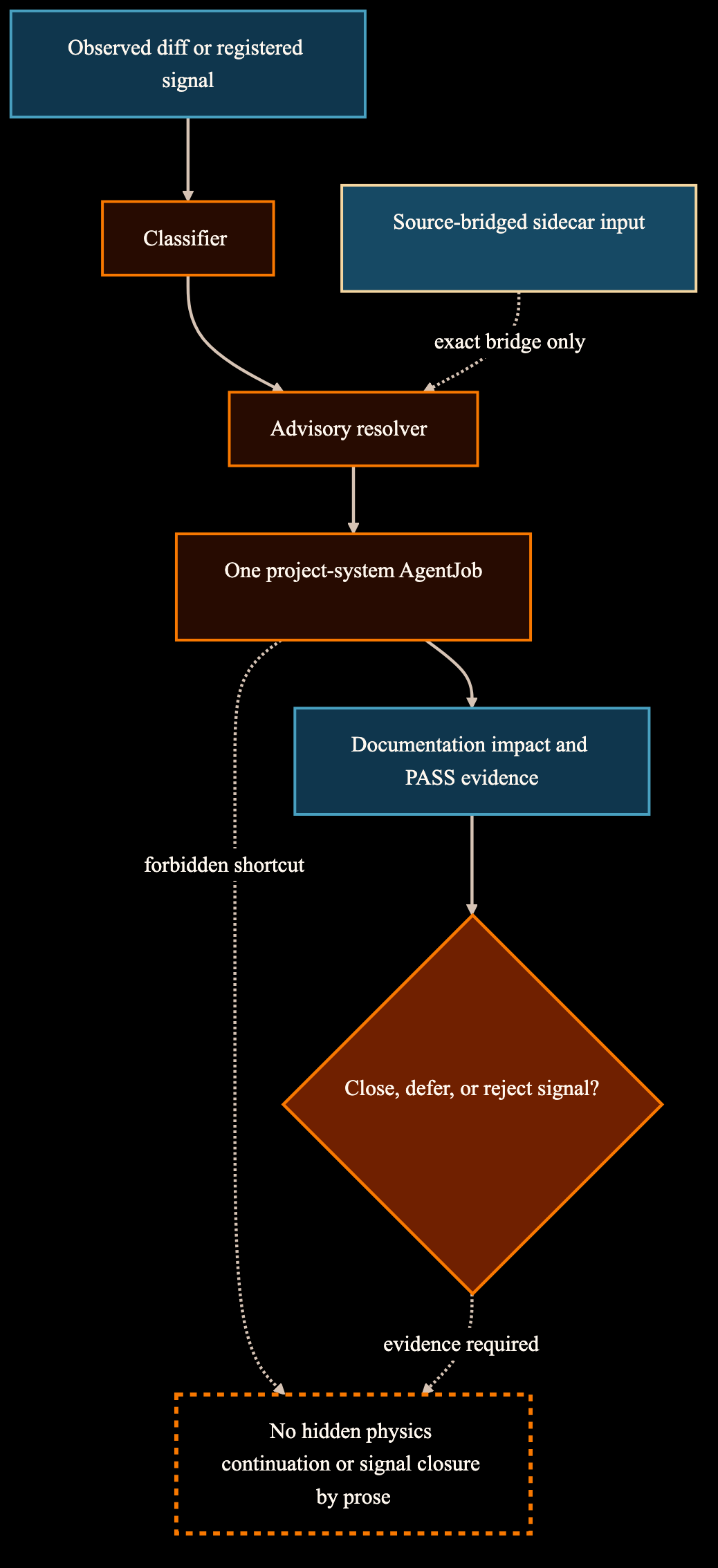
The repair loop starts when observable evidence identifies friction through a current working-tree diff, a registered open signal, a repeated workflow problem, or a source-bridged project-improvement sidecar from a qualifying completion. Memory may locate earlier context, but tracked source files and registry rows must be inspected before that context affects action.
A classifier describes the issue as documentation drift, a validator gap, routing ambiguity, a schema problem, or another registered signal type; an advisory resolver ranks the candidate; and the Director routes one bounded AgentJob with an explicit write-path allowlist and claim boundary. When a repair changes project state, a documentation-impact receipt records affected source surfaces, generated derivatives, classifier reason codes, and required validators.
Completion and handoff records preserve the result, while a signal closes only with matching PASS completion evidence or a documented rejection decision. A project-improvement sidecar is a separate maintenance input and never replaces the normal research handoff; a resolver recommendation alone neither authorizes nor blocks checkpointing; and a registered role or descriptive perspective does not activate authority.
This Project-System Improvement page explains that reliability loop for readers, but no diff, classifier, resolver, sidecar, signal, registry row, documentation-impact receipt, validator PASS, completion, handoff, commit, AI output, or webpage independently proves a physics claim, completes the open first-principles derivation, promotes the proposed ontology or a benchmark, grants role authority, expands an allowlist, or authorizes research continuation.
Static diagram
The improvement diagram shows signal, classification, sidecar input, one AgentJob, evidence receipts, and close/defer/reject outcomes.
Bounded repair loop
The improvement loop is useful because it treats friction as evidence, classifies it, and repairs one concrete surface with explicit closeout.
| Input | Classification | Allowed output |
|---|---|---|
| Observed diff or repeated workflow problem | Classify the issue as documentation drift, validator gap, routing ambiguity, schema problem, or tooling reliability signal. | A bounded project-system candidate, not a physics continuation. |
| Registered signal | Check signal type, severity, evidence, current status, and required closure receipt. | One repair route with explicit close, defer, or reject evidence. |
| Source-bridged sidecar | Use exact-path source evidence as support context for the proposed maintenance action. | A scoped input; never a global allowlist or replacement handoff. |
| Resolver recommendation | Rank the next repair using current state, open signals, and allowed project-system scope. | Advisory routing below validators, allowlists, and live control records. |
Review evidence
The closeout should say exactly what was repaired, what was checked, and what remains outside the packet.
| Artifact | What it supports | What it does not support |
|---|---|---|
| One bounded repair | A specific project-system issue was addressed inside an allowed packet. | The repair does not promote physics claims or continue research by implication. |
| Documentation-impact receipt | State-changing documentation or control-surface effects were recorded for audit. | The receipt is not owner acceptance, Gate Chair approval, or source adoption. |
| Validator PASS | The named check accepted the checked maintenance state. | PASS is not a theorem check, scientific verdict, or global workflow guarantee. |
| Signal closure | A signal was closed, deferred, or rejected with explicit evidence. | Signals do not disappear by assertion or because a page says they are fixed. |
Blocked overreads
The safest maintenance system names the conclusions it cannot draw.
| Overread | Correction |
|---|---|
| Project-system improvement is not research continuation. | It repairs the machinery around research control; a separate live research packet is needed for research work. |
| A sidecar replaces the normal handoff. | A sidecar can inform routing only inside its exact source-bridged scope. |
| Resolver output alone blocks or authorizes checkpointing. | Resolver output is advisory unless a validator, allowlist, source authority, or live record creates the gate. |
| A maintenance packet can quietly alter source claims. | Project-system repair does not promote physics claims, role authority, or Gate Chair decisions. |
Source basis
This page explains project-system repair from dossiers, PRDs, script documentation, and workflow boundaries without changing the source project.
| Source area | Used here for | Authority boundary |
|---|---|---|
| Project-system improvement dossier | Signal, classifier, resolver, sidecar, one-job repair, and documentation-impact framing. | Dossier summaries do not close signals without matching evidence. |
| Project-control script documentation | Classifier, resolver, signal collection, sidecar validation, and documentation-impact validation roles. | Tooling supports maintenance routing; it cannot mutate research claims by itself. |
| Workflow and runtime requirements | One-packet execution, validators, completion, handoff, and checkpoint interpretation. | Operational evidence stays below source authority and human gates. |