01
Ontology
Plain-language terms for AEther, AEther-flow, observed space, S-time, expansion language, and gravity-language.
Open routePhysics Research
Start with the exact effective gravity package, then inspect its proposed Æther / Æther-Flow interpretation, open foundational derivation, and source evidence.
The Æther Flow Project is a two-part research program about foundational physics and the governed, human-accountable AI research system used to organize and test that work. This Physics Research page follows the physics track: a proposed Æther / Æther-Flow interpretation paired with an effective gravity package that uses general relativity as its exact observable benchmark.
The effective package is complete within its stated scope, but deriving general relativity from explicit substrate variables remains an open research problem, and the project does not claim a verified new law of gravity. The page helps readers distinguish the proposed ontology, the adopted benchmark, the remaining derivation burdens, and the source evidence that governs each statement.
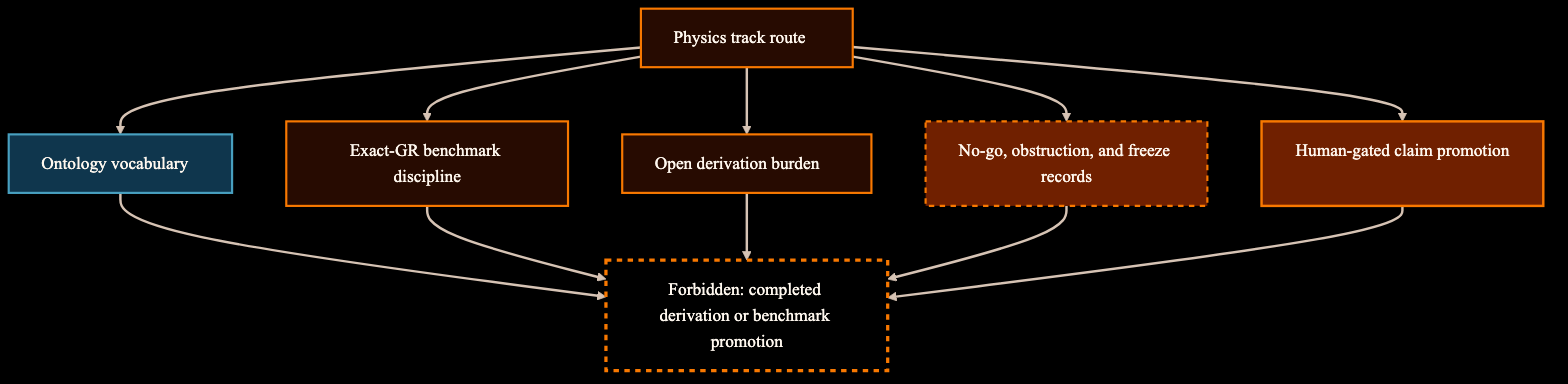
Static diagram
The diagram separates ontology, exact-GR benchmark status, derivation burdens, claim gates, and source authority so the route does not collapse orientation into proof.
Reader route map
Start with ontology if the vocabulary is new, or move directly to the benchmark, roadmap, flow-geometry, claim-status, and open-burden pages as those packets become technically ready.
01
Plain-language terms for AEther, AEther-flow, observed space, S-time, expansion language, and gravity-language.
Open route02
Benchmark compatibility boundaries without treating compatibility as a source-side derivation.
Open route03
The open burden chain for effective geometry, matter coupling, field equations, and benchmark promotion.
Open route04
Geometry-facing explanation constrained by source-bundle evidence and open derivation status.
Open route05
Claim gates, allowed wording, forbidden overreads, and gate-required statements.
Open route06
Remaining proof, model, and evidence burdens before stronger public claims are available.
Open routeClaim status
The safe reading is not a single success or failure claim. It is a controlled map of what each layer can and cannot say.
| Layer | Safe use | Boundary |
|---|---|---|
| Ontology vocabulary | Names the proposed substrate and flow-language that the project studies. | Vocabulary does not prove equations, predictions, or GR recovery. |
| Exact-GR benchmark | Preserves ordinary GR behavior as the public benchmark boundary. | Benchmark compatibility is not a first-principles derivation. |
| Derivation burden | Tracks what a source-side bridge would still need to show. | The GR derivation remains open under current source authority. |
| Obstruction record | Preserves negative results and frozen routes with scoped labels. | A scoped obstruction is not global theory rejection or promotion. |
Source basis
The page is a reader-facing synthesis. Stronger scientific statements require upstream source records, registered files, and claim gates.
| Source area | Used here for | Authority boundary |
|---|---|---|
| Generated physics explainer | Public orientation and five-layer status framing. | Generated noncanonical surface. |
| Ontology Markdown and registered TeX references | Vocabulary and source-authority distinction. | Registered sources outrank website copy. |
| Claim-boundary registry | Allowed, forbidden, and gate-required wording. | Registry rows constrain copy but do not prove claims. |
Source-reviewed positioning
The ordered statements below come directly from the reviewed public-claim ladder. Detailed qualifications remain available without displacing the effective result from the first reading path.
01 · What the project is
The Æther / Æther-Flow vocabulary supplies the package's proposed ontological and interpretive setting; it does not add a second observer-level field law or an established low-energy signal beyond general relativity.
The ontology is a proposed interpretation within the project, not an observed preferred-frame field or empirical evidence for new low-energy physics.
02 · Why exact closure matters
The exact-closure package adopts Einsteinian metric dynamics with one operative metric and universal matter coupling; adoption means use of that effective dynamics without claiming derivation from substrate variables.
Adopted means used as the effective benchmark; it does not mean derived, recovered, or proved from the Æther / Æther-Flow substrate.
03 · What exists now
At the effective level, the active exact-closure package is complete as an operational theory statement: its observable gravitational content is that of general relativity.
Complete refers only to the adopted effective theory for its stated matter sector, initial data, and boundary conditions; it does not mean that substrate microphysics has been derived or independently validated.
04 · What remains open
A first-principles derivation of Einsteinian gravity from explicit Æther / Æther-Flow substrate variables remains open.
Open means not completed; a roadmap, candidate, validator result, or scoped obstruction does not cross the derivation gate.
The project does not claim a completed substrate derivation, a unique underlying substrate action, an independently verified low-energy sector beyond general relativity, or a new observer-level gravitational law.
A nonclaim prevents overstatement; it does not prove the opposite proposition or validate the ontology.
05 · How the work is tested and governed
AI assistance may support drafting, mathematical exploration, branch screening, organization, and revision, but it does not convert speculative steps into established physics or remove the need for expert human review.
This is a methodological provenance statement, not external peer review, a human signature, proof authority, or independent scientific validation.