Workflow
Workflow
Read how roles enter one bounded workflow through task-local records.
Open routeAI Research System / Roles and Schemas
Roles classify responsibilities and schemas constrain records; neither creates proof or live permission without the task-local workflow boundary.
The Æther Flow Project is a two-part research program about foundational physics and the governed, human-accountable AI research system used to organize and test that work. Its physics track asks whether ordinary general relativity can be interpreted, and eventually derived, from a deeper Æther or Æther-Flow foundation; general relativity remains the exact benchmark for observable gravity, while the first-principles substrate derivation is still open.
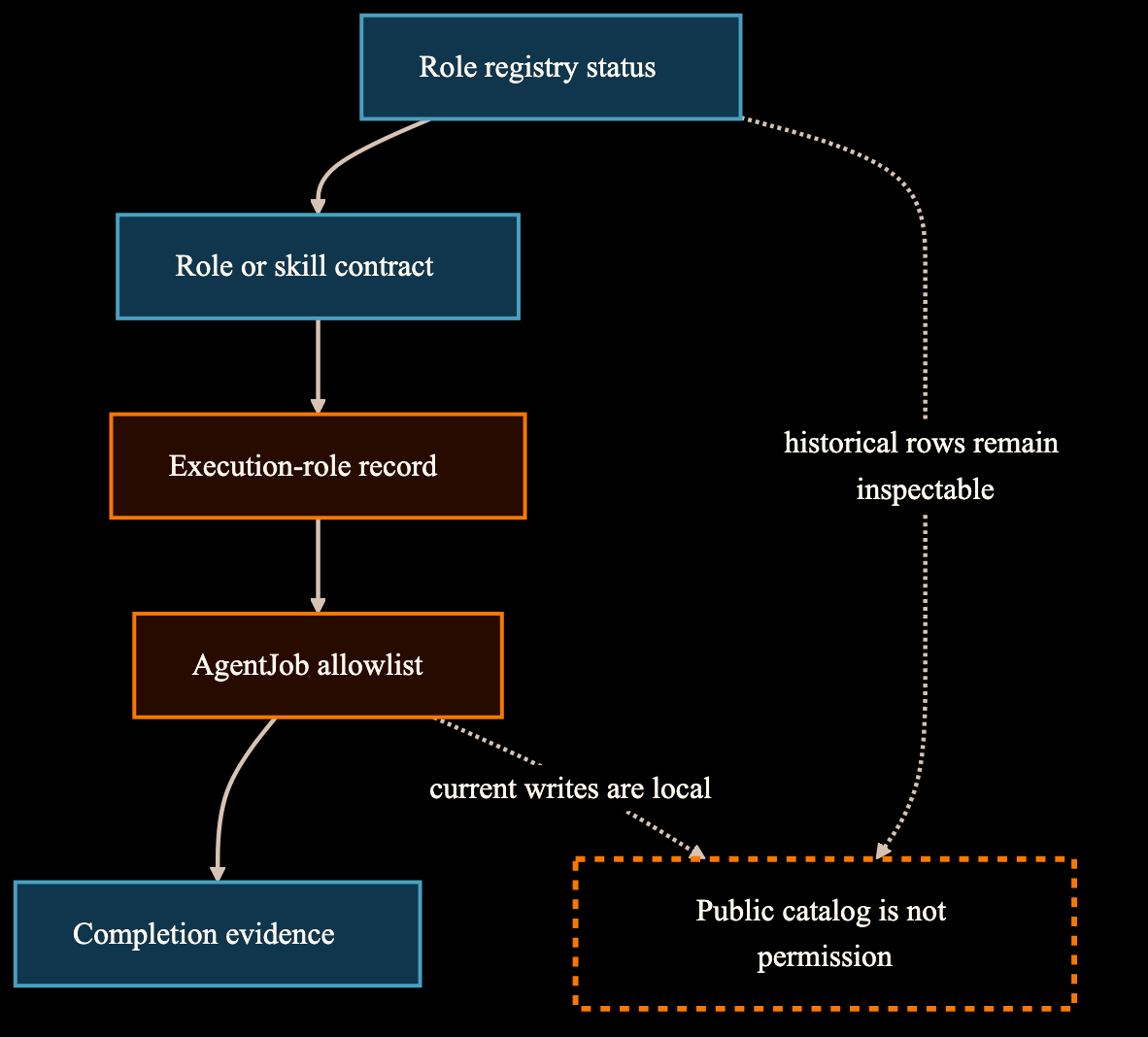
The AI track divides responsibility among named roles and uses schemas—required field definitions for control records—to keep each action inspectable. A registered role is only a stable template describing normal responsibilities, outputs, validators, and human-gate status; it becomes current authority only when a task-local execution-role record binds it to one AgentJob and that job names the allowed files, claim boundary, checks, and stop conditions. The binding may use the registered role directly, a one-job task overlay, or a provisional role that expires with its job and cannot be reused until formally registered.
This page explains how role registries, versioned contracts, execution records, AgentJobs, schemas, completion evidence, and human gates fit together so readers can distinguish a label from live permission. Roles may route, draft, audit, refute, document, validate, or maintain approved project surfaces, but no role, schema, registry row, validator PASS, or website page independently proves a physics claim or promotes the proposed ontology; protected promotion remains on the human-gated Gate Chair path and requires explicit tracked approval.
Static diagram
The role stack shows that labels, schemas, execution-role records, AgentJob allowlists, and validators occupy distinct authority layers.
Schema map
Each schema matters because it defines required fields, validators, and authority consequences for a record class.
| Schema | Controls | Reader explanation | Boundary |
|---|---|---|---|
| Role Schema | Registered role contracts | Defines role identity, version, authority fields, validators, outputs, and human-gate status. | A registered contract is a template until a task-local record binds it. |
| Director Decision Schema | Director Decision Records | Makes routing reasoning inspectable and superseded rather than silently rewritten. | A decision routes one job; it does not settle scientific truth. |
| AgentJob Schema | Bounded executable contracts | Defines objective, allowed reads, allowed writes, validators, memory preflight, expected outputs, and claim boundary. | The AgentJob is one transaction, not reusable permission. |
| Execution Role Schema | Task-local role bindings | Distinguishes registered role, task overlay, and one-job provisional role semantics for one AgentJob. | Task overlays and provisional roles expire with the owning job unless separately registered. |
| Documentation Impact Schema | Project-system documentation receipts | Records whether project-system changes require documentation updates and how generated derivatives were handled. | A receipt accounts for effects; it does not make derivatives authoritative. |
No-proof status
Roles can contribute routing, construction, audit, refutation, documentation, validation, or human-gated decision records. Proof still depends on source mathematics and tracked governance.
| Question | Safe reading | Proof boundary |
|---|---|---|
| Can route work | Some roles may classify, select, or recommend one bounded next step. | Routing is not proof and does not grant writes outside the AgentJob. |
| Can create draft/control artifacts | Roles may create candidates, audits, refutations, documentation, validators, or repair receipts inside an allowlist. | Output creation does not adopt source claims or prove the artifact's target. |
| Can modify project-control files | Project-control roles may modify allowed control surfaces inside a tracked job. | Project-control authority does not modify physics source status. |
| Can promote protected scientific claims | Only explicit human-gated authority can promote, close, or suspend protected claims. | The default answer for automated roles is no. |
| Creates proof authority | No role, schema, registry row, execution record, validator, or website page creates proof authority by itself. | Proof still depends on source mathematics, tracked approvals, and applicable governance records. |
Source basis
This route explains how to read roles and schemas. It does not resolve a fresh registry snapshot, register a role, or activate a human gate.
| Source area | Used here for | Authority boundary |
|---|---|---|
| Role contracts and role registry | Active-version resolution, role status, authority level, outputs, and human-gate state. | Registry visibility supports provenance; it is not proof or execution authority. |
| Schema contracts | Role, Director decision, AgentJob, execution-role, and documentation-impact artifact shapes. | Schema shape is control contract behavior, not claim adoption. |
| Workflow and claim-boundary records | Execution-role binding, one-job allowlist, completion evidence, and blocked-overread language. | The current job boundary governs any actual execution. |