01
Current physics state
Read active task, latest handoff, open burden, blocked claims, and next action.
Open routeDocuments / Reading Paths
Choose the path closest to your question or discipline. Each path begins with an internal explanation, preserves the strongest inference it does not authorize, and leads to source inspection only when needed.
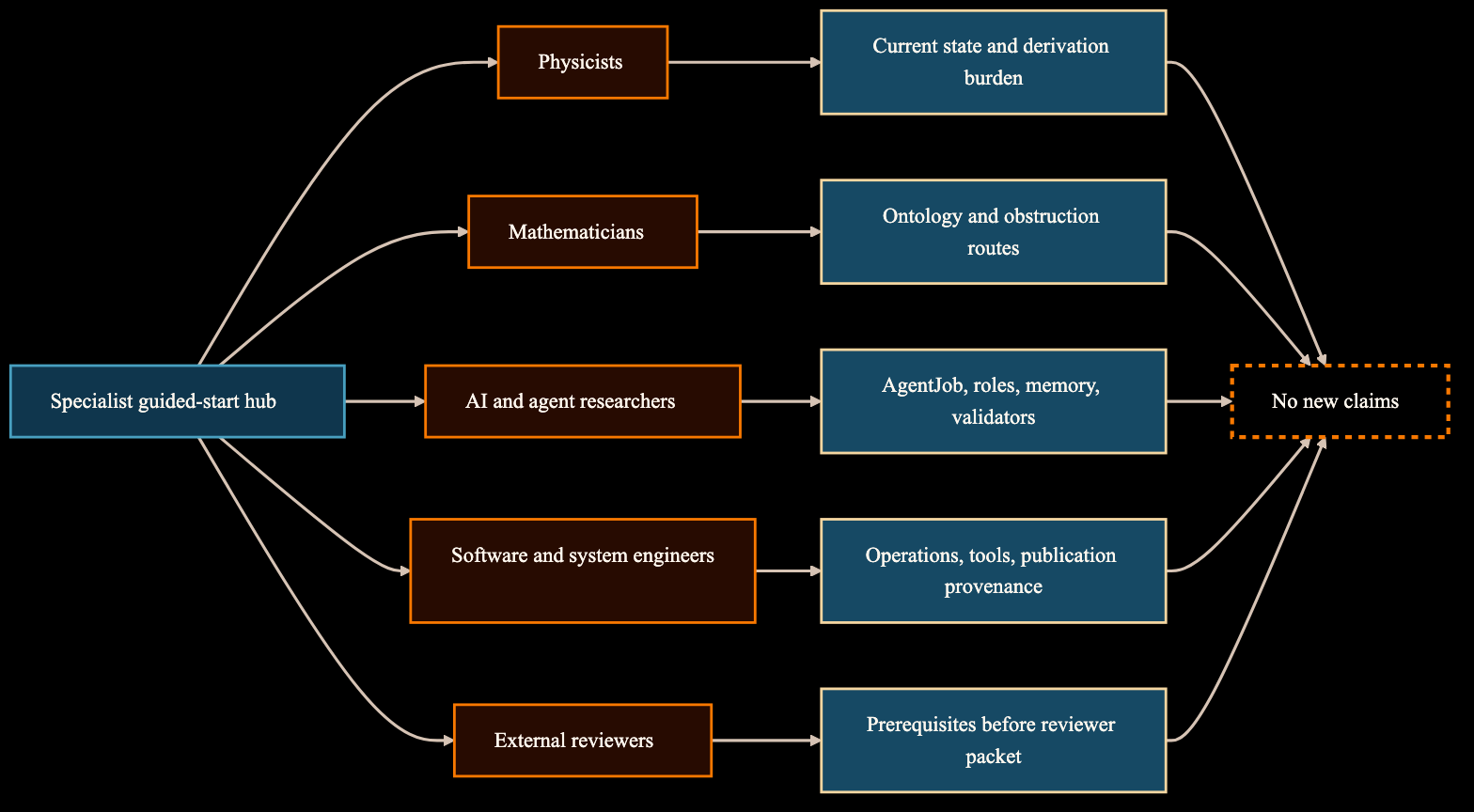
How to use this index
These paths are navigation layers. They lower the cost of finding the relevant pages without replacing the records that own claim status.
Audience paths
Every path follows one rule: read canonical internal pages first, then use source links and manifests as provenance when auditing a claim or artifact.
Physicists
This path is for readers asking what the physics program currently claims, where the open GR burden sits, and which stronger claims remain blocked.
01
Read active task, latest handoff, open burden, blocked claims, and next action.
Open route02
Inspect derivation burdens as ledger-backed blockers, not as a progress score.
Open route03
Read vocabulary and ontology status before treating terms as derived physics.
Open route04
Separate benchmark compatibility from first-principles derivation.
Open route05
Check proposal, audit, obstruction, freeze, and gate boundaries.
Open routeMathematicians
This path is for readers checking formal objects, route constraints, finite examples, no-target-import discipline, and local negative results.
01
Start with definitions and status boundaries before reading technical routes.
Open route02
Inspect open source, metric, matter-coupling, equation, and promotion burdens.
Open route03
Read why response tokens remain below metric data and `g_eff` construction.
Open route04
Check the fail-closed boundary around target topology, atlas, metric, and benchmark imports.
Open route05
Read local obstruction scope without converting it into global rejection.
Open routeAI and agent researchers
This path is for readers studying bounded AgentJobs, role records, parent-child synthesis, memory retrieval, validators, and completion evidence.
01
Start with the track landing for workflow scope and authority boundaries.
Open route02
Read the bounded request, Director, AgentJob, validation, completion, and handoff sequence.
Open route03
Inspect the single-job envelope for reads, writes, validators, outputs, and stop conditions.
Open route04
Check why role authority requires current task-local records.
Open route05
Read source-first retrieval discipline and generated-memory limits.
Open routeSoftware and system engineers
This path is for readers reviewing system operation, maintainer workflows, validation evidence, project-system repair, and publication provenance.
01
Start with the operational landing for lifecycle, routing, validation, publication, repair, and tools.
Open route02
Read why command PASS is checked-state evidence, not theorem proof or role authority.
Open route03
Inspect brief, source spec, public page, screenshots, human review, and manifest discipline.
Open route04
Check publication, provenance, registry, retrieval, and source-authority boundaries together.
Open route05
Read tool tiers without confusing capability with authorization.
Open routeExternal reviewers
This path prepares a reviewer to inspect source status, current burdens, and authority boundaries before opening research artifacts.
01
Begin with the public first path if the project framing is unfamiliar.
Open route02
Read the active source-state snapshot before inspecting deeper claims.
Open route03
Inspect open derivation burdens and blocked downstream promotions.
Open route04
Read the trust boundary for website pages, generated derivatives, and upstream records.
Open route05
Use the collection guide for registered TeX sources and corresponding PDF manifestations.
Open route