1. Registry
Read status and gate fields
Start with role id, version, authority level, status, human-gate state, may/may-not fields, output form, validators, and notes.
AI research-agent deep dive / PG-017
A role label is not live permission. To inspect authority, read the role registry, role contract, execution-role record, AgentJob allowlist, completion evidence, and any required human gate.
Static comprehension diagram
The diagram is a static reader aid generated from the dossier Mermaid source. It does not replace the registry, contracts, execution-role records, AgentJobs, completions, or human gates.
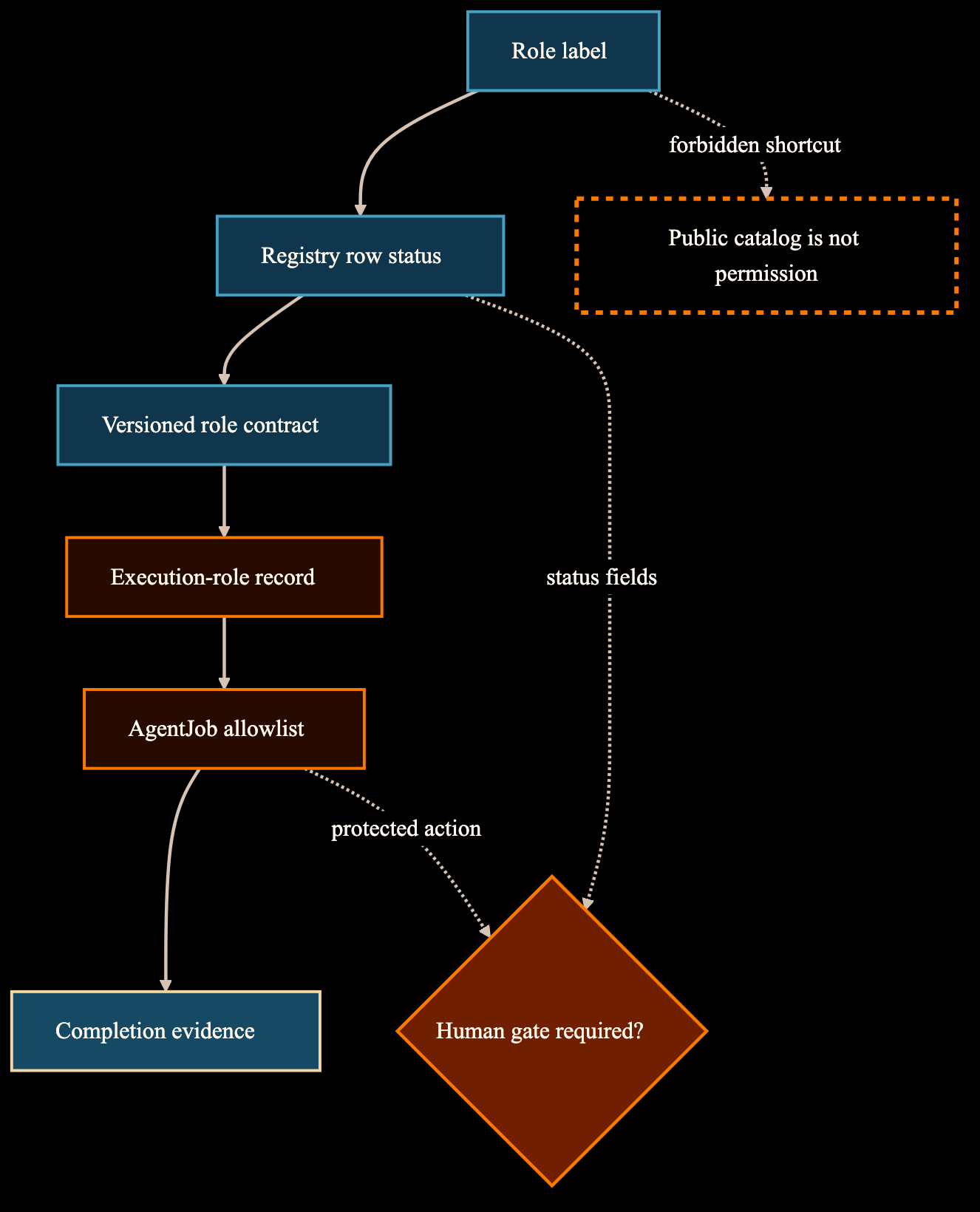
Authority inspection stack
The safe reading path starts with source-visible role status and ends with a current AgentJob boundary and completion evidence.
1. Registry
Start with role id, version, authority level, status, human-gate state, may/may-not fields, output form, validators, and notes.
2. Contract
The role contract is the governed text. A public page can summarize it, but cannot replace it.
3. Execution role
The current job must bind the role through `registered_role`, `task_overlay`, or `one_job_provisional_role`.
4. AgentJob
Actual transaction authority comes from allowed reads, writes, outputs, validators, source classes, and claim boundary.
5. Completion
Completion evidence records what changed, which commands passed, what verdict was reached, and what remains blocked.
6. Human gate
A human-gated role or claim-promotion path requires explicit tracked approval, not just a visible registry row.
Representative registry readings
These examples are representative committed rows, not a live permission console. Source inspection remains in the upstream registry.
active
Authority: routing_control
Gate: not human-gated
may modify sources: false; may promote claims: false
Safe: Can route bounded work under the current control process when a task and AgentJob authorize it.
Unsafe: Director label grants all write authority.
active
Authority: science_draft
Gate: not human-gated
may modify sources: false; may promote claims: false
Safe: Can produce bounded draft/control formalization only when the AgentJob allows that work.
Unsafe: Role name adopts ontology or source law.
status_defined
Authority: human_gated
Gate: requires human gate
may promote claims: true; may execute autonomously: false
Safe: The role exists, but execution and promotion require explicit tracked approval.
Unsafe: Gate Chair row visibility authorizes promotion.
active
Authority: project_control
Gate: not human-gated
may modify sources: true; may promote claims: false
Safe: Can maintain project-control surfaces inside the current AgentJob allowlist.
Unsafe: Project-control role can promote physics.
superseded
Authority: routing_control
Gate: not human-gated
historical row retained for old execution records
Safe: Visible for audit history and old-record interpretation.
Unsafe: Superseded visibility means current active authority.
Boundaries
The inspector is useful only if it keeps catalog display, registry status, role contracts, and live transaction authority separate.
Registry
A registry row establishes source-visible status; it does not authorize a live transaction.
Contract
A role contract explains normal scope; the AgentJob controls current reads and writes.
Active
Active status still needs a task-local execution-role record and AgentJob.
Superseded
Superseded rows stay visible so older task records remain interpretable.
Gate
A human-gated role requires explicit tracked approval before protected action.
Catalog
This website page cannot register roles, supersede roles, or promote claims.
Safe and unsafe summaries
A public role inspector can orient readers. It cannot register roles, activate roles, change role status, change write permission, or promote physics claims.
Safe summary
Read registry row, role contract, execution-role record, AgentJob allowlist, completion evidence, and any human gate.
Unsafe summary
It would be unsafe to treat a role name, catalog card, active status, or historical row as current write or claim authority.
Reader path
The route is a reader layer. Source links remain provenance for readers who need to inspect the committed registry and contracts.