Guided starts / specialists
Specialist Guided Starts
Choose the path closest to your discipline. Each path points to existing internal routes and names the strongest inference it does not authorize.
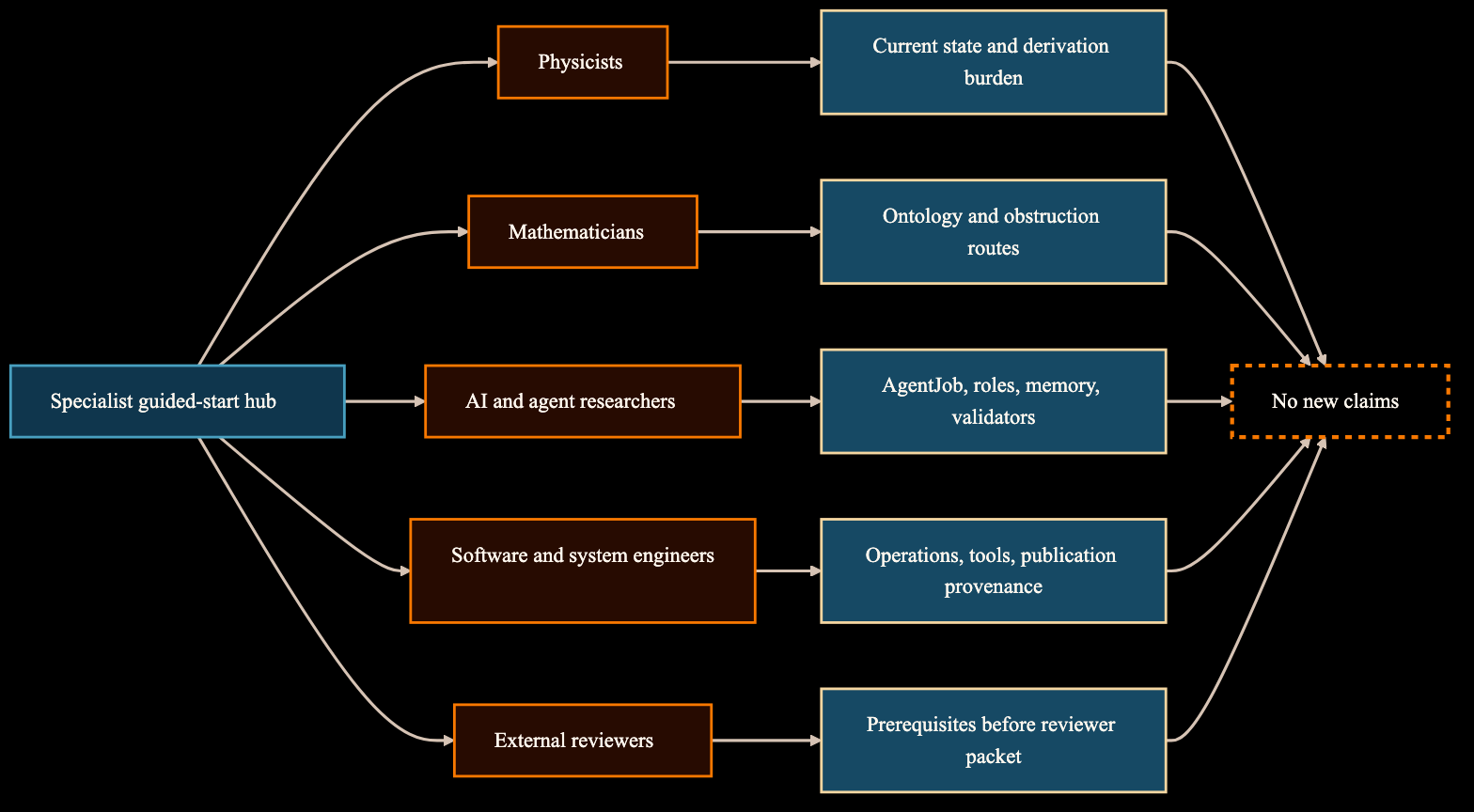
How to use this hub
Read by discipline, then inspect source authority.
These paths are navigation layers. They help a specialist find the relevant pages quickly, but they do not replace the source records that own claim status.
- Route type
- Guided-start hubOne resources route with anchored specialist paths through already sourced pages.
- Audience
- Specialists and reviewersPhysicists, mathematicians, AI/agent researchers, software/system engineers, and external reviewers.
- Boundary
- No new claimsThe hub recommends reading order and caution; it does not update source state or prove claims.
- Reviewer status
- Prerequisites onlyThe reviewer path points to prerequisite pages. The dedicated reviewer packet remains PG-026 work.
Audience paths
Pick the route family that matches your review question.
The sections below share one rule: read internal pages first, then use source links and manifests as provenance when you need to audit a claim or artifact.
Physicists
Start with current status, then inspect the derivation boundary.
This path is for readers asking what the physics program currently claims, where the open GR burden sits, and which stronger claims remain blocked.
01
Current physics state
Read active task, latest handoff, open burden, blocked claims, and next action.
Open route02
Distance-to-GR dashboard
Inspect derivation burdens as ledger-backed blockers, not as a progress score.
Open route03
Ontology
Read vocabulary and ontology status before treating terms as derived physics.
Open route04
Exact-GR benchmark
Separate benchmark compatibility from first-principles derivation.
Open route05
Claim gates
Check proposal, audit, obstruction, freeze, and gate boundaries.
Open route- Do not infer
- Boundary for this pathDo not infer completed first-principles GR derivation, `g_eff`, matter coupling, Einstein equations, benchmark promotion, or downstream GR promotion.
Mathematicians
Follow definitions, construction burdens, and obstruction scope.
This path is for readers checking formal objects, route constraints, finite examples, no-target-import discipline, and local negative results.
01
Ontology
Start with definitions and status boundaries before reading technical routes.
Open route02
GR derivation roadmap
Inspect open source, metric, matter-coupling, equation, and promotion burdens.
Open route03
Metric response ladder
Read why response tokens remain below metric data and `g_eff` construction.
Open route04
No-target-import discipline
Check the fail-closed boundary around target topology, atlas, metric, and benchmark imports.
Open route05
Negative results and frozen routes
Read local obstruction scope without converting it into global rejection.
Open route- Do not infer
- Boundary for this pathDo not infer existence, uniqueness, regularity, or global impossibility from a reading path, diagram, local freeze, or finite toy result.
AI and agent researchers
Read workflow authority before evaluating agent behavior.
This path is for readers studying bounded AgentJobs, role records, parent-child synthesis, memory retrieval, validators, and completion evidence.
01
AI Research-Agent System
Start with the track landing for workflow scope and authority boundaries.
Open route02
Workflow walkthrough
Read the bounded request, Director, AgentJob, validation, completion, and handoff sequence.
Open route03
One bounded AgentJob
Inspect the single-job envelope for reads, writes, validators, outputs, and stop conditions.
Open route04
Role authority inspector
Check why role authority requires current task-local records.
Open route05
Memory registries
Read source-first retrieval discipline and generated-memory limits.
Open route- Do not infer
- Boundary for this pathDo not infer that AI workflow owns physics decisions, validator PASS is proof, or role labels grant authority without task-local records.
Software and system engineers
Inspect operation, validation, publication, and tool boundaries.
This path is for readers reviewing system operation, maintainer workflows, validation evidence, project-system repair, and publication provenance.
01
Operations
Start with the operational landing for lifecycle, routing, validation, publication, repair, and tools.
Open route02
Validator PASS limits
Read why command PASS is checked-state evidence, not theorem proof or role authority.
Open route03
Publication process
Inspect brief, source spec, public page, screenshots, human review, and manifest discipline.
Open route04
Publication and provenance system
Check route maps, page provenance, source manifests, asset manifests, and hash boundaries.
Open route05
Technical requirements
Read tool tiers without confusing capability with authorization.
Open route- Do not infer
- Boundary for this pathDo not infer that tool availability is authorization, build success is scientific truth, or manifest presence replaces source review.
External reviewers
Read prerequisites before the dedicated reviewer packet.
This path is a staging route. It prepares a reviewer to inspect source status and claim boundaries before PG-026 creates `/resources/reviewer-packet/`.
01
General-public guided start
Begin with the public first path if the project framing is unfamiliar.
Open route02
Current physics state
Read the active source-state snapshot before inspecting deeper claims.
Open route03
Distance-to-GR dashboard
Inspect open derivation burdens and blocked downstream promotions.
Open route04
Source authority
Read the trust boundary for website pages, generated derivatives, and upstream records.
Open route05
Ontology documents
Use the reading guide for registered TeX sources and generated PDF derivatives.
Open route- Do not infer
- Boundary for this pathDo not infer that this section is the reviewer packet, a review invitation, or evidence that scientific claims are complete.
Safe reading
The guide is useful because its authority is narrow.
- Safe summary
- Audience-specific route orderSpecialist guided starts tell each audience which existing internal pages to read first and what overreads to avoid.
- Unsafe summary
- Guided start equals proofA guided start creates claims, updates current source state, proves physics or mathematics, grants AI/role authority, or replaces the future reviewer packet.
Related routes
Return to shared authority pages when a path feels too narrow.
The general-public guide and source-authority pages remain the common baseline for every specialist path.
General-public guided start
Use this first if the project frame is unfamiliar.
Open routeSource authority
Read the shared trust boundary behind all guided starts.
Open routeClaim Boundary Explorer
Inspect allowed, forbidden, and gate-required wording.
Open routeDiagram Gallery
Browse visual aids by concept with non-authority captions.
Open route