Operations explainer

Technical Requirements

Technical requirements define which tools are needed to perform an operation. They do not decide whether the operation is authorized.

Technical requirement tiers
Visual orientation only: working tools support reproducibility without creating source authority.

Tooling comprehension

Tool availability supports reproducibility; it is not authorization.

Technical requirements explain inspection tools, validation tools, browser rendering, and TeX/PDF derivative tooling while keeping permission in source-control records.
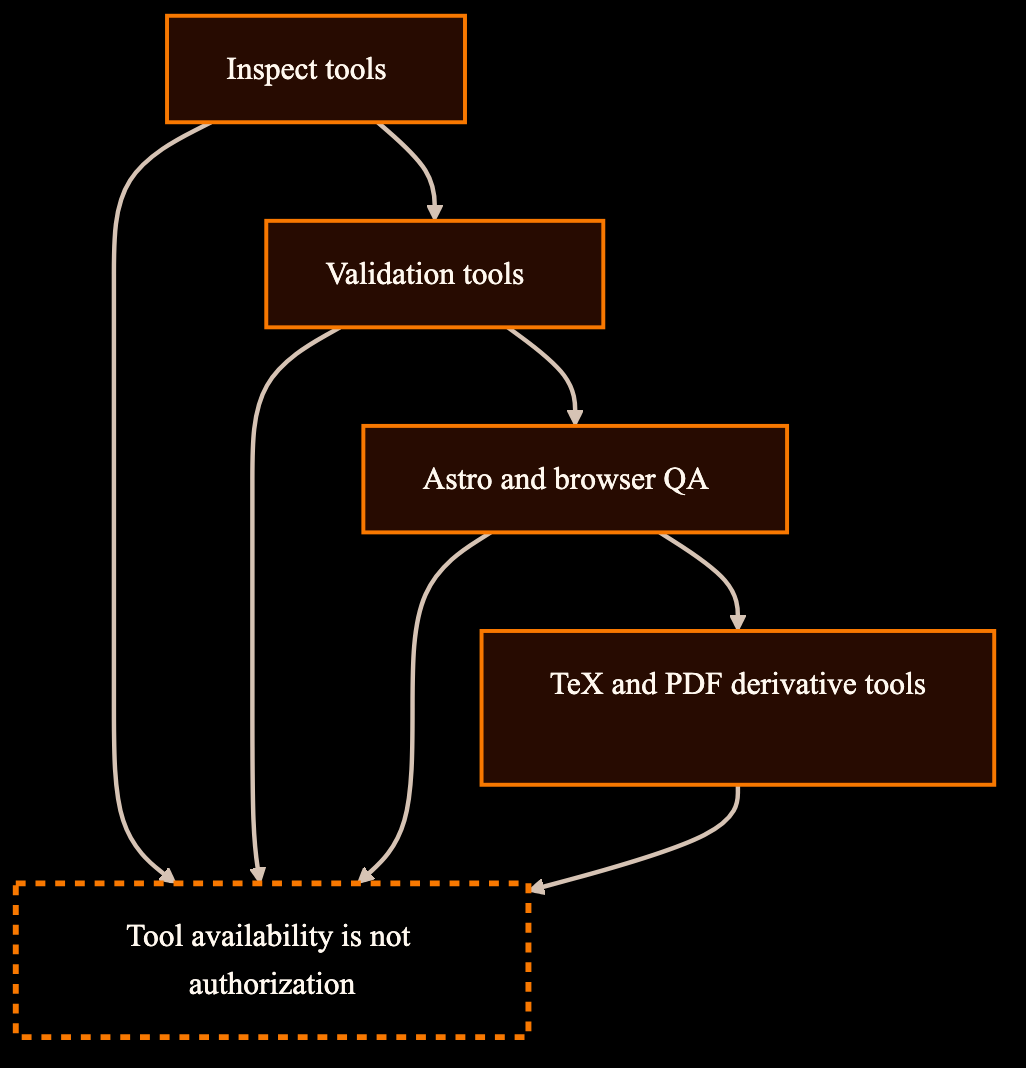
Diagram showing inspect tools, validation tools, Astro and browser QA, TeX and PDF derivative tools, and tool availability is not authorization.
Static comprehension diagram: tools make operations reproducible without deciding whether an operation is allowed.Mermaid source: docs/content-dossiers/operations-technical-requirements/diagrams/technical-tool-authority-tiers.mmd. Manifest id: comprehension_operations_technical_tool_tiers.

The diagram is a static reader aid. It does not replace the source files, route dossiers, or claim-status records that govern the topic.

Mechanism

How to read this surface.

Terms

Define the loaded words before using them.

Tool tier
A class of local capability needed for a kind of operation.Not permission.
Derivative tooling
Tools used to generate human-readable outputs such as PDFs.The source file remains authority when registered.

Boundaries

What this page must not imply.

No command-as-authority
Successful tools do not grant scopeAuthorization remains in the current records and gates.
No dependency policy change
The page is descriptiveIt cannot change repository dependencies, validators, or command semantics.

Safe reading

A useful summary also names the unsafe one.

Safe summary
Supported readingTechnical requirements identify tools needed to inspect, validate, render, or derive artifacts, while authorization remains in task and source-control records.
Unsafe summary
Forbidden shortcutInstalled tools, passing commands, or local capability authorize work, change dependencies, or promote scientific claims.

Related routes

Source basis

Use these as provenance, not primary navigation.

Tool tiers

Use the tier that fits the operation.

Read-only inspection, governed agent work, Python checks, memory refresh, HTML QA, and PDF derivative work have different tool requirements.

Inspect
Browser, editor, shell, GitRead-only inspection has minimal requirements and does not authorize edits.
Validate
Python environmentRepository-owned validators and tests provide deterministic evidence for changed surfaces.
Render
Astro and browser QAPublic website work needs static build checks and rendered evidence where layouts changed.
Derive
Managed PDF lanePDF derivatives belong to registered TeX source workflows and remain human-readable derivatives.

Authority boundary

Capability and authorization are separate questions.

A complete local toolchain can make a check reproducible. It still cannot create permission, alter command policy, or promote a scientific claim.

Capability
The tool can runSuccessful execution shows the local environment can perform the operation that was requested.
Authority
The source records decide scopeTasks, roles, AgentJobs, validators, and source registries still decide whether the operation is allowed.

Related reading

These links keep the primary reader journey inside the website. Source links remain visible in the provenance section.

Source provenance

Source links are for inspection, not primary navigation.

The links below point to reviewed upstream source surfaces. This website adaptation remains downstream from those sources and from the registered authority records they cite.

Source authority