Role
Gate Chair is human-gated
The role is defined for protected promotion, closure, or suspension decisions, but execution and promotion require explicit tracked approval.
Physics deep dive / PG-004
Some scientific decisions are deliberately protected. Gate Chair authority is the human-gated path for promotion, closure, or suspension decisions after required evidence exists; readiness signals do not make the decision themselves.
Validator and routing limits
The public failure mode is claim laundering: reading an operational receipt, registry row, or next-action note as if it were a protected scientific decision.
Cannot decide
Validator success cannot adopt source law, prove a theorem, authorize MetricData(E), change g_eff scope, or promote downstream GR claims.
Cannot decide
A handoff records status and next action. The next action is not already executed, even when it names a gate or future packet.
Cannot decide
A role registry row helps inspect default authority. The live transaction still needs explicit tracked gate approval.
Cannot decide
Generated or website pages orient readers. They do not supersede source records, registries, role contracts, or human-gated decisions.
Current handoff example
The current source-state example is bounded: Gate Chair accepted the recovery-bridge candidate only as scoped source-extension evidence/precondition. That is a protected evidence-status decision, not coupling-law adoption, matter-coupling derivation, benchmark promotion, or completed derivation.
Preserved boundary
This boundary remains in force for the public reading of the current handoff unless upstream source authority explicitly changes it.
Preserved boundary
This boundary remains in force for the public reading of the current handoff unless upstream source authority explicitly changes it.
Preserved boundary
This boundary remains in force for the public reading of the current handoff unless upstream source authority explicitly changes it.
Preserved boundary
This boundary remains in force for the public reading of the current handoff unless upstream source authority explicitly changes it.
Preserved boundary
This boundary remains in force for the public reading of the current handoff unless upstream source authority explicitly changes it.
Preserved boundary
This boundary remains in force for the public reading of the current handoff unless upstream source authority explicitly changes it.
Preserved boundary
This boundary remains in force for the public reading of the current handoff unless upstream source authority explicitly changes it.
Preserved boundary
This boundary remains in force for the public reading of the current handoff unless upstream source authority explicitly changes it.
Preserved boundary
This boundary remains in force for the public reading of the current handoff unless upstream source authority explicitly changes it.
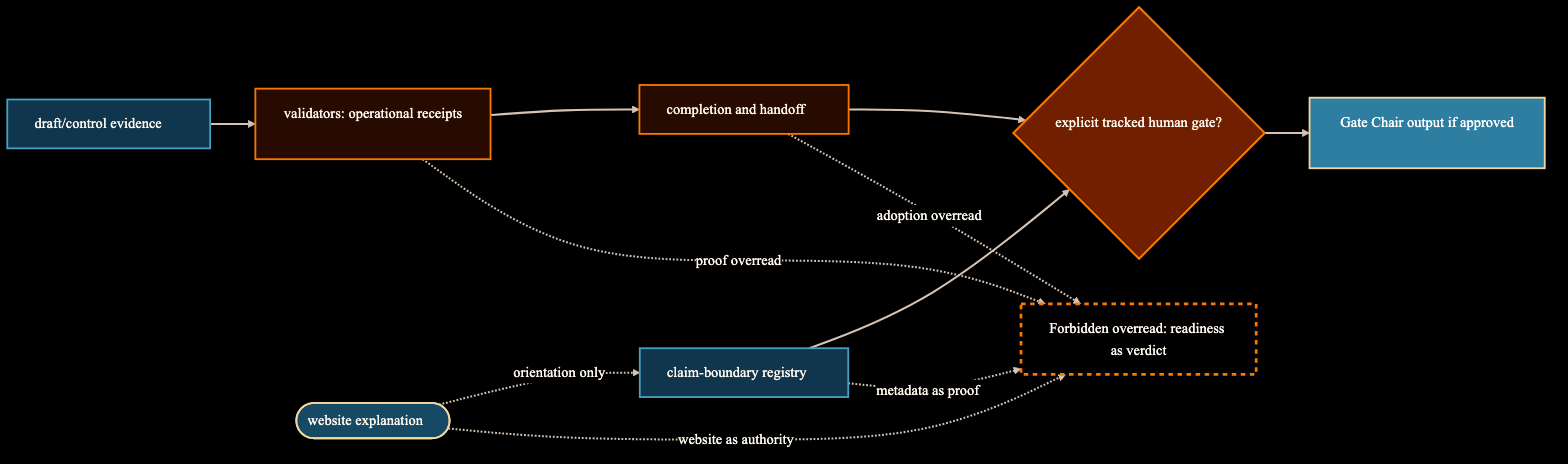
Public comprehension diagram
The static diagram separates lawful preparation from protected authority. Dashed paths mark places where records, validators, or public explanation could be overread as a verdict.
Safe summary
Safe summary: Gate Chair authority is a protected human-gated decision path. Draft/control evidence, validators, completions, handoffs, and registries can prepare or record context, but only explicit tracked approval can authorize a Gate Chair execution or protected promotion.
Unsafe summary
Unsafe summary: A validator passed, a selector routed toward a gate, a handoff named a next action, or a role row exists; therefore a Gate Chair verdict has occurred or downstream GR claims are promoted.
Reader path
Human-gated status is easiest to understand when read beside the source-extension pipeline, claim gates, current state, and source authority route.