Resources / Reading Paths
Reading Paths
Reading paths choose the internal route sequence before source links, manifests, or repository files appear. They organize comprehension; they do not create authority.
The logical path is question first, route second, provenance third. Internal explanations help readers understand what they are auditing before they inspect source files, registries, manifests, or generated derivatives.
Static diagram
Route readers by audience and question while preserving source boundaries.
The specialist guided-starts diagram shows audience-specific paths into internal pages before provenance links or source inspection.
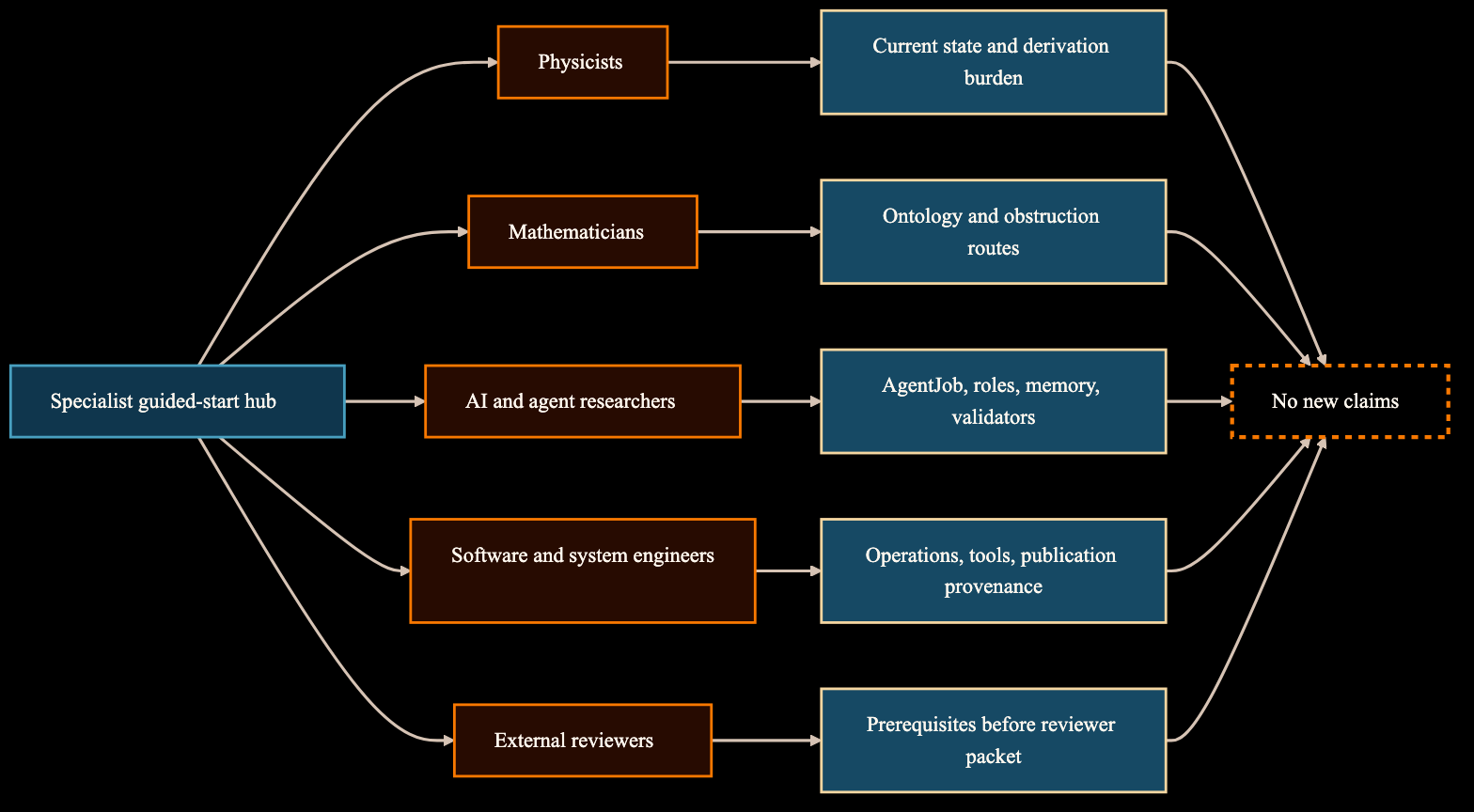
Audience paths
Start with the reader job, not the repository tree.
Each path starts at a short website route and keeps claim boundaries visible before source or provenance inspection.
| Reader | First route | Recommended path | Reason |
|---|---|---|---|
| General reader | / | Home, Resources, Guided Starts, then the topic route that answers the question. | The project frame and claim boundaries appear before technical detail. |
| Physics reviewer | /physics/ | Physics Research, Ontology, Exact-GR Benchmark, Derivation Roadmap, Claim Status, Open Burdens. | Claim state, benchmark status, and open derivation burdens stay visible. |
| AI workflow reviewer | /ai-research-system/ | AI Research System, Workflow, AgentJob Lifecycle, Roles and Schemas, Validators and Handoffs. | Operational authority is read through bounded records instead of inferred from automation. |
| Contributor | /resources/source-authority/ | Source Authority, Repository Map, Site Builder Guide, Publication Process, then the relevant page family. | The edit boundary and source bundle precede implementation or copy changes. |
| Site builder | /resources/site-builder-guide/ | Site Builder Guide, Repository Map, Publication Process, Library, then the target route family. | A source-bundle-first path prevents building from derivative seed material alone. |
| Asset reviewer | /resources/ | Resources, Generated Derivatives, Documents, Diagram Gallery, then manifest or provenance records. | Assets are read with status labels before hashes or source links dominate. |
Question router
Use the question to select the route.
The route choice is a reading convenience. It does not decide source status, claim status, or implementation permission.
| Question | Route | Boundary |
|---|---|---|
| What is the project? | Home and Resources | The site explains the dual physics and AI workflow mission without claiming a completed GR derivation. |
| What claims are currently allowed? | Physics Claim Status | Claim status pages explain tracked states; they do not promote blocked or open claims. |
| How does the AI system control work? | AI Workflow | Workflow pages describe bounded AgentJobs and evidence receipts, not proof of physics. |
| Where should I inspect source and derivatives? | Source Authority and Registries | Authority classes and registry rows guide inspection but remain below upstream source and governed records. |
| How should a page be built? | Site Builder Guide | Source bundles are implementation orientation, not unrestricted write permission. |
Route clusters
Short routes are the public reading surface.
Use internal pages for orientation and source/provenance links for audit after the route has explained the subject.
Start
Home
Begin with the subject-level frame before route families or source records.
Open routePhysics
Physics Research
Follow claim status, source ontology, benchmark, roadmap, and open-burden routes.
Open routeAI workflow
AI Research System
Read governed workflow, roles, memory, runtime, validators, and handoffs.
Open routeResources
Resources
Use manifests, library routes, derivatives, retrieval, documents, and diagrams with status labels.
Open routeBuilder
Site Builder Guide
Map page families to source bundles before implementation starts.
Open routeTopology
Repository Map
Separate source, control, generated, local, tooling, archival, and reserved lanes.
Open routePolicy
Reading paths keep comprehension ahead of file inspection.
A path is safe when it lowers cognitive load without hiding source, derivative, retrieval, or freshness status.
| Rule | Meaning | Failure mode |
|---|---|---|
| Internal route first | When a website route exists, it is the primary reader path. | A GitHub link or file path becomes a substitute for explanation. |
| Status before provenance | The route should identify source, derivative, retrieval, snapshot, or planning status before source links. | A reader sees a polished surface and silently upgrades its authority. |
| Audience before repository | Choose the path by reader job, then expose files and manifests as audit tools. | Repository archaeology appears before the reader understands the subject. |
| Freshness where current state appears | Current-state paths must identify source precedence and refresh expectations. | A dated snapshot is read as current fact. |