Resources / Registries
Registries
Registries are provenance and status maps. They help readers find the owner of a claim, but they do not prove physics or promote claims.
A registry row can expose where evidence lives, what status was recorded, and which boundary applies. It cannot replace reading the source it describes.
Static diagram
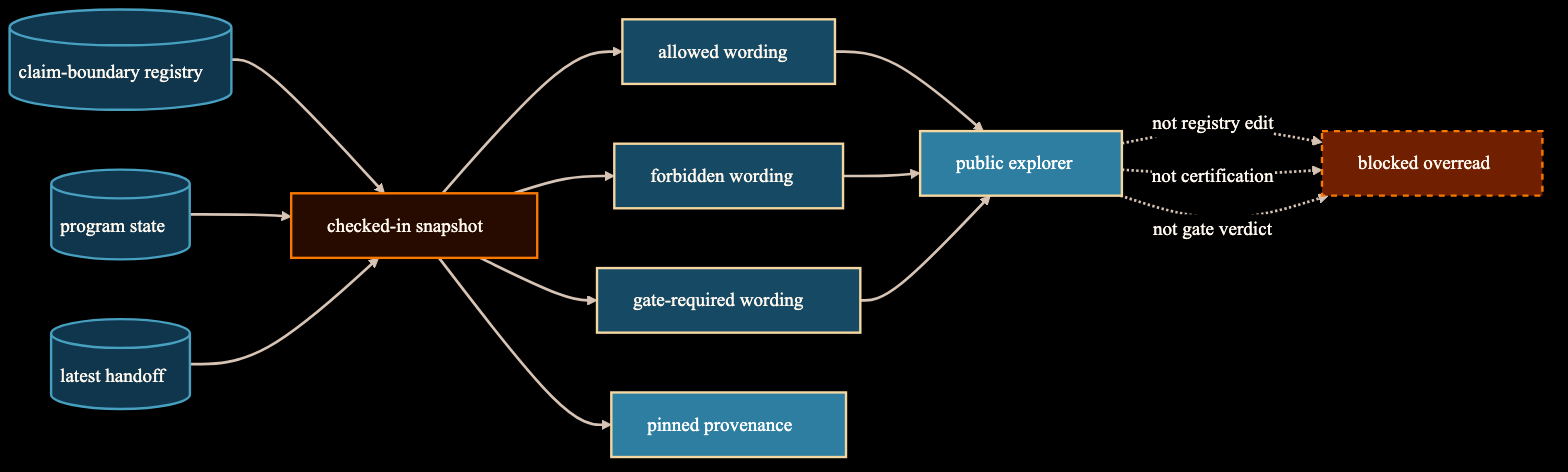
Read registries as typed control records.
The claim-boundary explorer diagram is reused to show how registry rows feed checked snapshots and public readers while forbidden overreads remain blocked.
Registry families
Rows are maps to evidence, not the evidence itself.
The registry page starts with families so readers do not mistake every CSV row for the same kind of authority.
| Family | Examples | What it can say | What it cannot say |
|---|---|---|---|
| Source registries | TEX_SOURCE_REGISTRY, MARKDOWN_SOURCE_REGISTRY, publication source listings. | Which tracked source lane exists and where to inspect it. | The registry row alone proves the source claim. |
| Derivative registries | PDF, HTML explainer, generated wiki, and semantic registries. | Which generated surface exists and how it relates to source material. | A generated surface has become canonical authority. |
| Workflow registries | AgentJob, Director decision, role-execution, research-task, and project-improvement signal registries. | What workflow state or operational record is discoverable. | The workflow record proves physics or expands role authority. |
| Claim and burden registries | CLAIM_BOUNDARY_REGISTRY and DISTANCE_TO_GR_LEDGER. | Allowed wording, forbidden overreads, status boundaries, and open burden labels. | A dashboard, burden label, or row closes the derivation. |
| Publication and relationship registries | PUBLICATION_BRIEF_REGISTRY and source/derivative relationship rows. | How reader surfaces, briefs, source specs, and outputs are connected. | Publication quality grants source authority. |
How to read a row
Registry use is a four-step source-inspection workflow.
A row is most useful when it is followed by owner inspection and a clear statement of what the row does not prove.
| Step | Action | Guardrail |
|---|---|---|
| Find the row | Use the registry to locate a source, derivative, task, role, claim boundary, or public asset. | Do not stop at the row when the claim depends on source text. |
| Inspect the owner | Open the source file, handoff, completion, publication brief, or manifest record named by the row. | The owner decides the claim class and current status. |
| Read status and date | Check approval status, freshness, source commit, or current-state boundary before reuse. | Outdated metadata is a maintenance signal, not proof or rejection. |
| Record the limit | State what the registry supports and what it cannot prove. | Registry dashboards show provenance and status; they do not prove physics claims. |
Proof limits
Positive registry signals stay scoped.
Registry metadata is important because it makes the project auditable. It remains metadata, not theorem proof or publication acceptance.
| Signal | Supports | Limit |
|---|---|---|
| Hash | File identity for a specific published or source object. | Hash integrity does not establish scientific correctness. |
| Approval status | Publication, asset, or review state for the named surface. | Approval status is not a theorem proof or source-law adoption. |
| Claim-boundary row | Allowed, forbidden, and gate-required wording for a scoped claim. | Boundary metadata does not execute the gate it describes. |
| Workflow row | Traceability for a task, job, role, or decision. | Traceability does not widen the original permission envelope. |
Related internal routes
Read registry rows beside source, memory, validator, and claim boundaries.
Registries are easier to interpret when their source authority and proof limits are visible.
Authority
Source Authority
Read the source, registry, derivative, and retrieval class ladder.
Open routeMemory
Memory Preflight
Use memory to find candidate registry rows without treating retrieval as authority.
Open routeChecks
Validators and Handoffs
Interpret PASS, handoff, and registry evidence at the right grain.
Open routeClaims
Physics Claim Status
Read public claim states with blocked overreads visible.
Open routeBurdens
Open Burdens
Use burden labels without turning them into progress proof.
Open routeResources
Resources Overview
Return to the Resources category landing page.
Open route