Resources / Source Authority
Source Authority
Use website pages to find the right source lane. Use registered sources, registries, and governed records to decide claim status.
This page is itself a Resources page, so its authority boundary appears as contextual copy and provenance metadata. It does not render a separate source-authority component block.
Static diagram
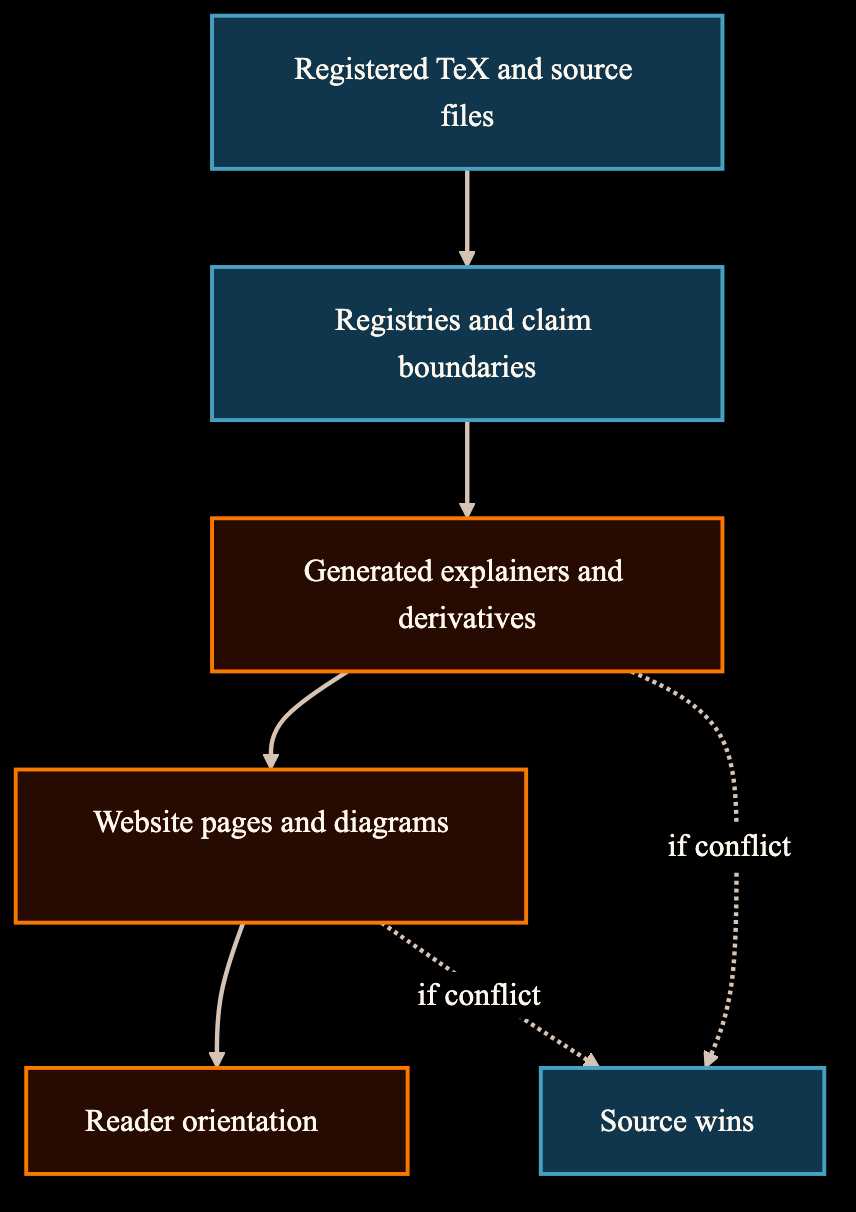
Keep website pages downstream from source authority.
The source-authority ladder shows source files and registries above generated derivatives, public pages, diagrams, and reader orientation.
Source-first checklist
Authority is resolved before claim wording is strengthened.
The checklist is deliberately conservative: identify the claim class, inspect the owner, handle conflicts, and state the non-scope.
| Step | Question | Outcome |
|---|---|---|
| Name the claim class | Is the statement physics, workflow, publication, registry, derivative, current-state, or route-implementation language? | Select the right authority lane before writing copy. |
| Inspect the owner | Which source file, registry row, handoff, completion, or PRD owns the statement? | Use the owner for status; use the website for explanation. |
| Check conflict rules | Does a derivative, memory hit, or page summary disagree with the source? | When source and derivative disagree, inspect the canonical source and current tracked control record. |
| Add the limit | What does the positive evidence not prove? | State the non-proof, non-promotion, or non-authority boundary near the evidence. |
Related internal routes
Use internal routes before provenance excavation.
Source authority connects to registries, memory, validators, claim status, and diagram status.
Records
Registries
Read how registry rows carry status and provenance without becoming proof.
Open routeMemory
Memory Preflight
Separate source-finding support from claim authority.
Open routeChecks
Validators and Handoffs
Keep validator PASS and handoff evidence below protected decisions.
Open routeClaims
Physics Claim Status
Read claim-state examples with blocked overreads visible.
Open routeResources
Resources Overview
Return to the Resources category landing page.
Open routeDiagrams
Diagram Gallery
Inspect visual aids as reader support, not authority.
Open route