Resources / Repository Map
Repository Map
The repository map classifies folder lanes by purpose, edit policy, and read policy. It is orientation for inspection, not a substitute for source inspection.
The repository combines source material, control records, registries, generated derivatives, tooling, tests, archival lanes, and ignored local caches. The safe question is not only where a file lives, but what authority class and edit policy that lane carries.
Static diagram
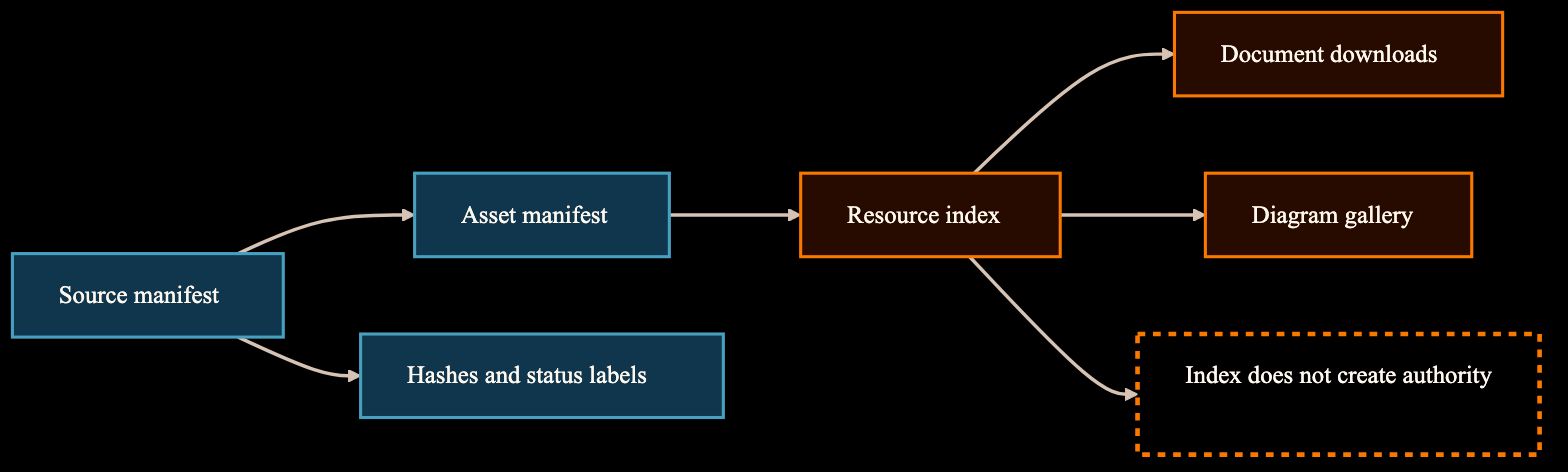
Read repository topology through manifest and source boundaries.
The manifest chain is reused here to keep canonical source, public assets, generated derivatives, resource routes, and no-authority boundaries visible while reading folder lanes.
Folder lanes
Read and edit boundaries differ by lane.
This compact map avoids copying a stale generated folder inventory. Future changes must re-check the live upstream tree before using this page as implementation context.
| Folder | Class | Edit policy | Read policy |
|---|---|---|---|
ontology/ | Canonical scientific source plus derivatives | Edit active source Markdown or registered TeX through governed source workflows; treat PDFs as derivatives. | Read ontology and TeX sources for claim-bearing material before generated explainers. |
research_control/ | Tracked control authority | Edit through bounded Director decisions, AgentJobs, completions, validators, and handoffs. | Read program state, frontier, tasks, approvals, design records, and handoffs for workflow state. |
registries/ | CSV authority and metadata ledger | Edit through governed workflows with validation receipts. | Use for source, derivative, role, job, decision, claim, relationship, and provenance rows. |
markdown/ | Canonical documentation and publication source | Edit briefs and source specs through documentation-curator or governed workflows. | Use publication briefs and HTML explainer specs as source-bundle inputs. |
github-facing/ | Generated source-backed Markdown derivative | Regenerate from source-backed publication process; do not hand-edit as source authority. | Use as reader-friendly seed material after source inspection. |
html/ | Tracked generated HTML derivative | Regenerate through the governed HTML explainer workflow. | Use as closest existing analogue for public website explanations. |
wiki/ and .local/ | Generated navigation and local retrieval support | Refresh or clean locally; never cite ignored cache state as authority. | Use for search, object browsing, QA, and retrieval hints only. |
.agents/ and .codex/ | Control contracts and tooling/runtime | Edit through project-control, role/schema, or skill-maintenance packets. | Use for role contracts, schema boundaries, skills, prompts, and workflow procedures. |
scripts/ and tests/ | Tooling and reliability checks | Edit with relevant tooling changes and tests. | Use for deterministic validation and operations; passing tests are operational evidence only. |
legacy_ontology/ and tex_shared/ | Archival and source-support lanes | Treat archival content as comparison material unless promoted by tracked authority; edit shared TeX support only through governed changes. | Use for historical comparison and shared source support, not independent claim promotion. |
Legend
Authority class is part of the data.
Folder names alone are not enough. Each lane must keep its source, derivative, local, tooling, or archival status visible.
| Class | Meaning | Reader warning |
|---|---|---|
| canonical scientific source | Active source material that may carry scientific or mathematical claims when registered and governed. | Derivatives help reading but do not replace the source. |
| tracked control authority | Tasks, approvals, program state, registries, validators, completions, and handoffs. | Controls workflow authority, not scientific truth by itself. |
| generated derivative | Human or agent-readable output generated from source material. | Read for orientation; edit sources and regenerate. |
| local retrieval | Ignored semantic, Obsidian, memory, preview, or QA state. | Use for search and review; do not cite as authority. |
| tooling/runtime | Skills, scripts, tests, prompts, dependencies, and operator helpers. | Validates or automates behavior, not physics proof. |
| archival or reserved | Historical, comparison, support, or future lanes without active registered authority by default. | Avoid building claims from it until source authority exists. |
Where should I edit?
Canonical changes start in the owning lane.
Generated outputs and local retrieval layers can help find the owner. They are not the owner.
| Change | Edit lane | Blocked shortcut |
|---|---|---|
| Physics or mathematical claim | Active ontology Markdown/TeX and associated registries through governed source workflows. | Generated explainers, diagrams, wiki notes, PDFs, or local retrieval hits. |
| Role or schema behavior | .agents/ contracts and related registries through project-control workflows. | Website copy or generated workflow summaries. |
| Research workflow state | research_control/ records, registries, AgentJobs, completions, and handoffs. | Memory summaries, screenshots, or static public pages. |
| Publication source or website seed | markdown/publication-briefs/ and markdown/html-explainer-specs/ before regenerating derivatives. | Generated HTML or GitHub-facing Markdown as an independent source. |
| Local retrieval support | Refresh or clean local caches as local tooling state. | .local material as public evidence. |
Related internal routes
Use topology beside builder, authority, retrieval, and publication routes.
The map supports source inspection; it does not replace the source bundle or the current tracked record.
Builder
Site Builder Guide
Turn topology into source bundles without treating the map as authority.
Open routeAuthority
Source Authority
Read source, registry, derivative, retrieval, and website authority classes.
Open routeRetrieval
Retrieval Layers
Separate local navigation support from source records.
Open routePublication
Publication Process
Follow source specs, briefs, derivatives, validation, and review limits.
Open routeReading
Reading Paths
Choose route sequences by reader question before file inspection.
Open routeResources
Resources Overview
Return to the Resources route map.
Open route