Resources / Library
Library
The Library is a reading surface. It organizes routes by reader job and keeps provenance visible without making repository structure the first task.
Library pages support reading paths with provenance and internal routes. They are not repository archaeology, proof surfaces, or source authority.
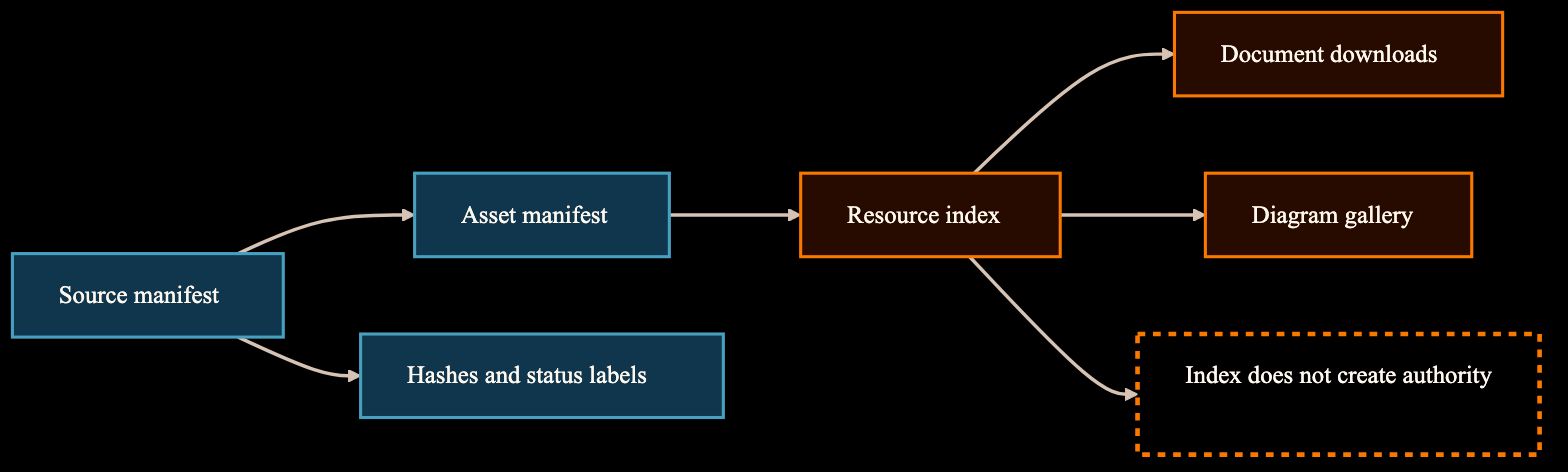
Static diagram
Read the library as an internal-first shelf map.
The manifest chain shows how reader routes, public files, manifest records, hashes, and status labels organize inspection without becoming authority.
Reader paths
Choose the path by question before opening files.
The library starts with reader intent so source links and manifests arrive as audit tools rather than as the first cognitive load.
| Reader | Recommended path | Reason |
|---|---|---|
| First-time reader | Start with Home, Resources, Guided Starts, then a topic route. | Context and claim boundaries appear before file or registry structure. |
| Physics reviewer | Use Physics Research, Claim Status, Open Burdens, Documents, then source provenance. | Claim state and open burdens come before generated derivatives or downloads. |
| AI workflow maintainer | Use AI Research System, Workflow, Validators and Handoffs, Memory Preflight, then records. | Operational authority and evidence limits remain visible. |
| Source/provenance reviewer | Use Source Authority, Registries, Publication Process, and Publication And Provenance System. | The review path separates source basis, route maps, manifests, and hash limits. |
| Site builder | Use Library, Publication Process, Repository Map, and Site Builder Guide when available. | Page type, reader job, and source bundle shape should precede editing. |
| Asset reader | Use Ontology Documents, Diagram Gallery, Generated Derivatives, and manifest links. | Downloads and diagrams keep source or derivative status attached. |
Library shelves
Shelves group reading jobs, not authority by implication.
A shelf can help readers find material. It cannot promote any page, asset, registry, or derivative above its source label.
| Shelf | Examples | Use | Limit |
|---|---|---|---|
| Reader starts | Home, Guided Starts, Reading Paths, Resources. | Choose a route sequence by audience and question. | A recommended path is not source authority. |
| Claim and source status | Source Authority, Claim Status, Open Burdens, Registries. | Understand authority class, allowed wording, and blocked overreads. | Status pages explain; tracked sources and records decide. |
| Publication and derivatives | Generated Derivatives, Publication Process, Publication And Provenance System. | Inspect how reader surfaces, manifests, and provenance are built. | Publication quality remains separate from claim authority. |
| Documents and diagrams | Ontology Documents, Diagram Gallery, public manifests. | Find readable assets with labels, hashes, and source references. | Asset hashes and diagrams do not prove scientific correctness. |
| Operations and workflow | Workflow, AgentJob Lifecycle, Roles and Schemas, Validators and Handoffs. | Understand how work is bounded, recorded, and validated. | Operational evidence does not become physics proof. |
Library policy
The library keeps comprehension ahead of provenance detail.
Provenance is essential, but it becomes most useful after the route has explained what the reader is inspecting.
| Rule | Implication | Failure mode |
|---|---|---|
| Reader job first | Organize pages by what the reader is trying to understand. | A file-type catalogue exposes repository structure before meaning. |
| Internal route first | Use website routes as the primary reading path when they exist. | A source link becomes a substitute for explanation. |
| Status label near material | Show source-backed, generated derivative, snapshot, planning, or retrieval status where it matters. | A polished page silently inflates authority. |
| Provenance after comprehension | Expose source and manifest links after the reader knows what they are auditing. | Process metadata overwhelms the topic and weakens comprehension. |
Related internal routes
Use the library beside publication, derivatives, retrieval, guides, documents, and Resources.
Internal routes remain the primary reader journey; source and manifest links remain provenance.
Publication
Publication Process
Read how page types, briefs, source specs, validation, and review shape library material.
Open routeDerivatives
Generated Derivatives
Distinguish generated reader aids from source authority.
Open routeRetrieval
Retrieval Layers
Use memory, semantic, wiki, and local layers as navigation support only.
Open routeGuides
Guided Starts
Use audience-specific reader paths before source archaeology.
Open routeDocuments
Ontology Documents
Inspect manifest-backed TeX and PDF materials with status labels.
Open routeResources
Resources Overview
Return to the Resources category landing page.
Open route